Capstone project: Reimagining Realist
Reimagining how agents access real estate data to power a $1.6M redesign proposal
Duration
Tools
Role
Product Designer, User Researcher
Collaborators
Kylie N., Jamie F., Jenny D., Eurie O.

Project Overview
Validating assumptions, surfacing new opportunities, and securing buy-in
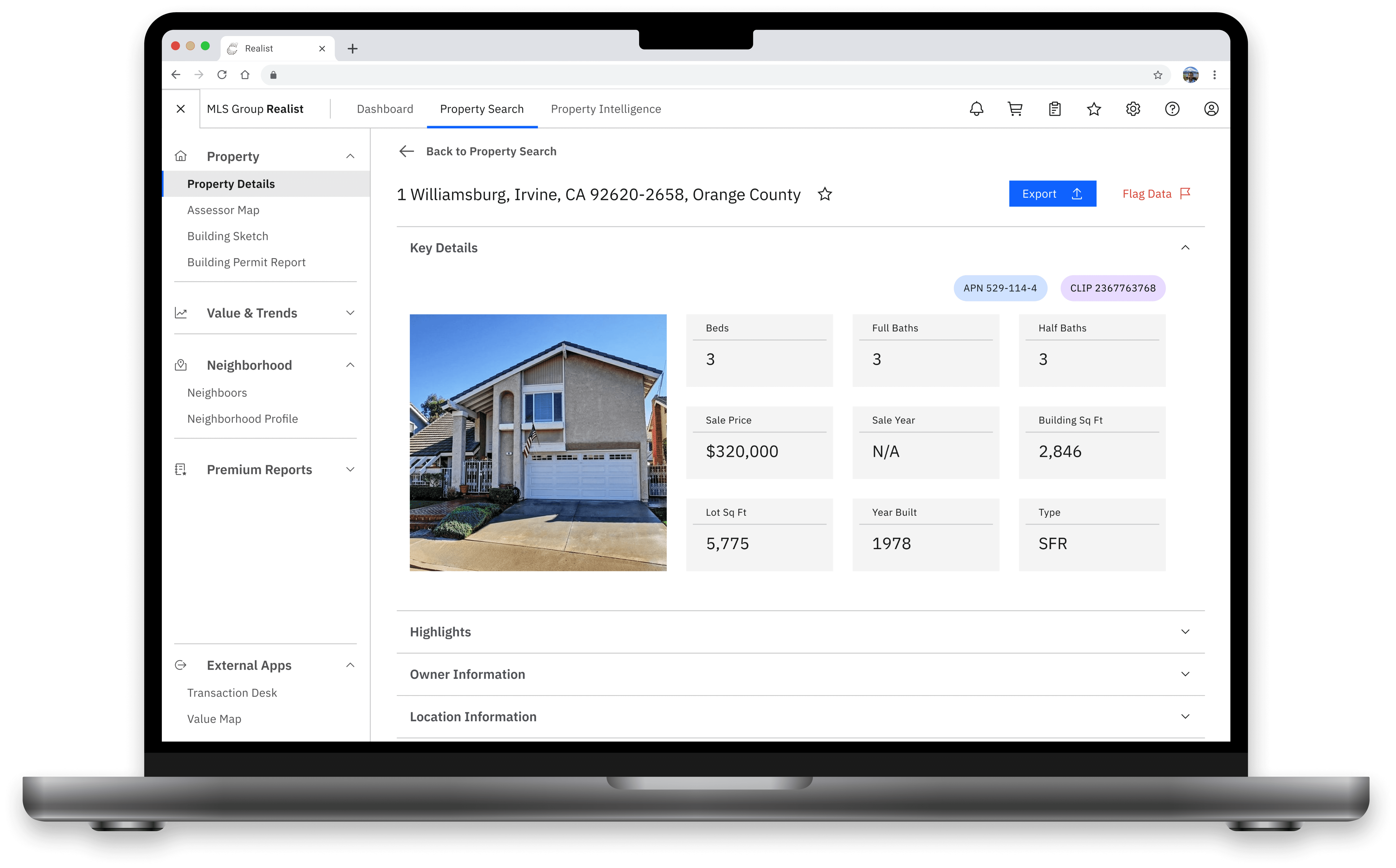
Realist is a nationwide property data platform under Cotality used by over 900,000 real estate agents, yet its navigation and key workflows have not evolved alongside agent needs.
Through multi-method research, my team and I uncovered opportunities to help agents surface critical insights faster and share them more effectively with their clients.
These insights informed new product concepts that clarified Realist’s value, revealed premium feature potential, and helped align teams around a shared vision, ultimately strengthening a $1.6M redesign proposal.


Context
Cotality’s two main assumptions gave us a starting point, but we needed to validate them
At the beginning of this project, our team was told to:
1) Promote premium reports
Improve how these reports are positioned and presented to make their value clear and compelling
2) Modernize the experience
Agents struggle with simple tasks on Realist, so Cotality is looking for a overhaul to stay competitive
The Problem
Agents' needs are growing, and Realist needs to make changes to stay competitive in the market
While Realist has been a leader in property tech for over 20 years, competitors are developing more streamlined workflows and modern client communication tools.
The current Realist experience uncovered over 200 violations in a heuristic evaluation, with contextual interviews revealing their two goals were to become a market expert and be able to share data easily with their clients - not necessarily wanting premium reports.

Usability tests revealed that consistent struggles with navigation and completing key workflows
Participants struggled to locate and export specific property data, despite Realist's comprehensive dataset, pointing to a gap between information available, and users' ability to efficiently access to it.
Notably, when agents did succeed in finding what they needed, they were pleasantly surprised by the level of detail available, even within the premium reports — suggesting the core issue was discoverability, not data quality.
Proposed Solution
A three pronged approach: workflow changes, blue sky thinking, and quick wins
I crafted a priority matrix to help order our proposed solutions, identifying 10 quick wins, 2 major initiatives, and 1 blue-sky concept. While all informed our recommendations, this case study highlights the Navigation update and Visual Report Builder (workflow changes), and the AI Highlights (blue sky), as they best demonstrate the balance between practical impact and forward-looking vision.
Concept Testing into Final Iterations
Validating before building revealed how agent feedback reshaped our design strategy
I led the design of the Property Details page, including a sidebar navigation redesign to improve clarity and scalability across agent workflows. I also shaped the AI Highlights concept and Custom Report Builder to better fit agent needs, validating all three through six concept-testing interviews with Realist agents — serving as interviewer and note-taker, then synthesizing insights to guide design direction.
Property Details Navigation
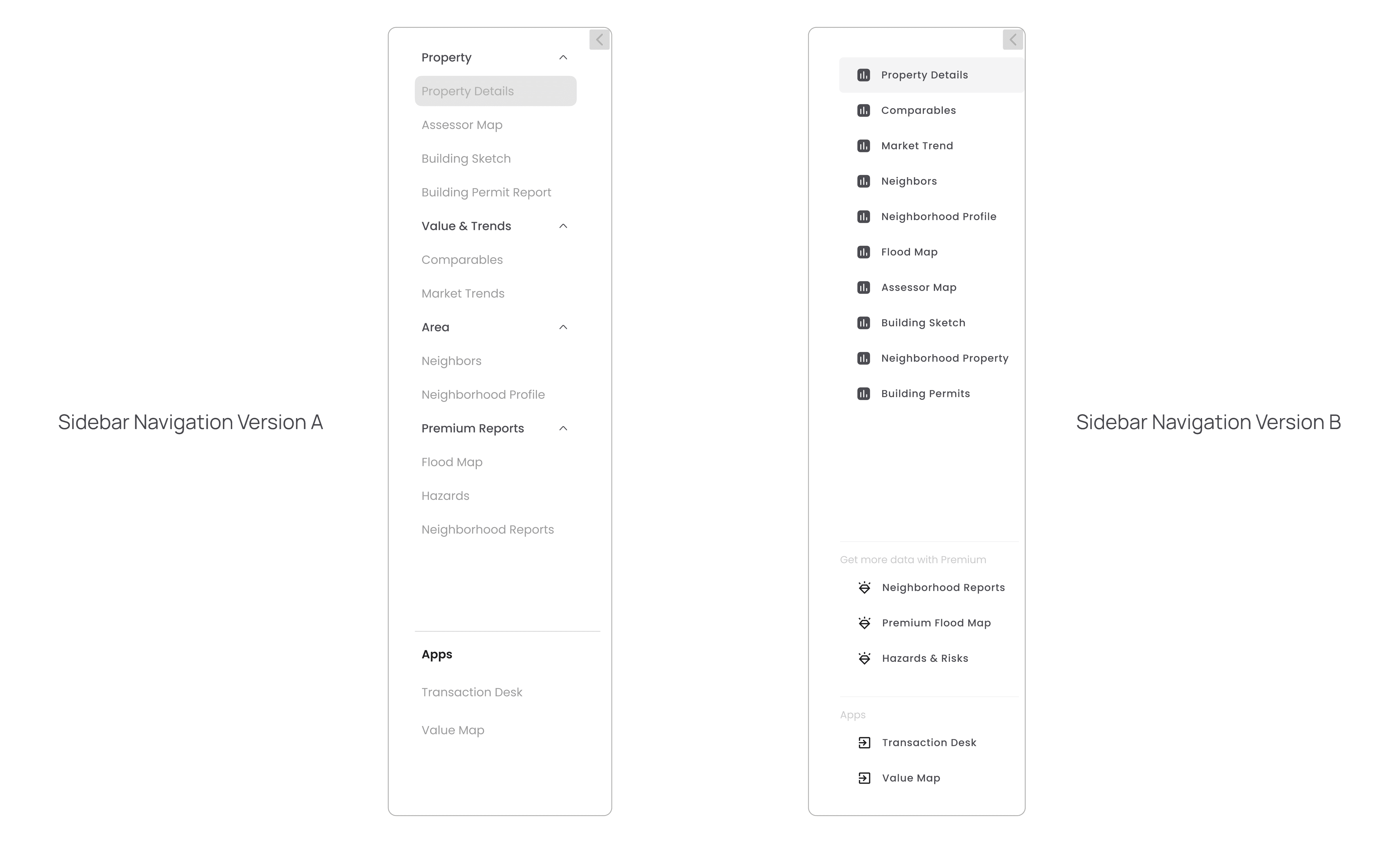
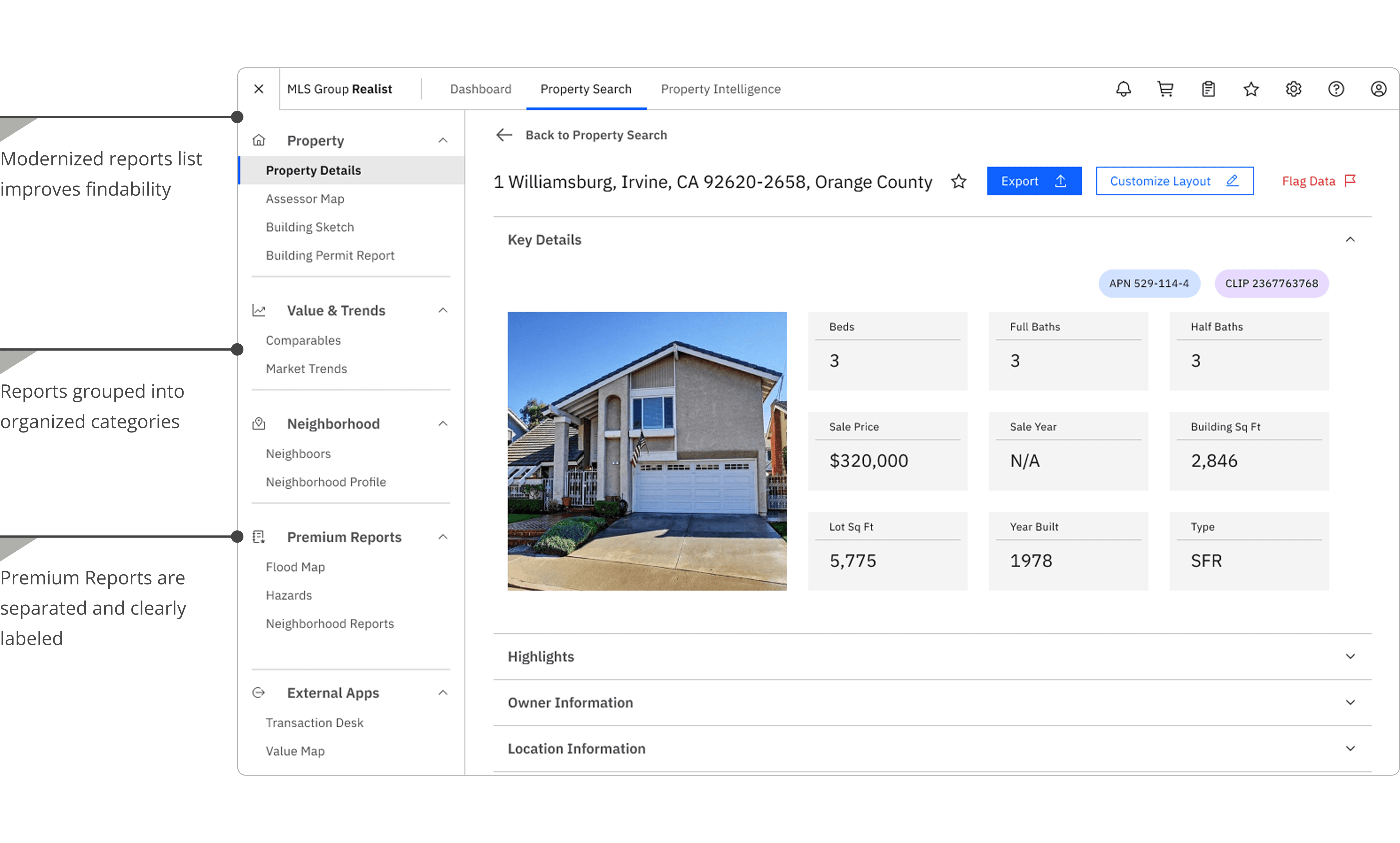
Agents consistently favored Version B, with targeted elements from Version A (icons and Premium report separation) integrated to strengthen the final solution.
By introducing a grouped, accordion-style sidebar, the redesigned navigation eliminates horizontal scrolling and transforms an overwhelming list into a scalable, well-organized system. Users can quickly open and close sections, improving discoverability and reducing mental effort when locating reports.
Visual Report Builder
The concept of the visual builder generated strong interest, as long as the interface remained intuitive and streamlined, however, testing revealed usability gaps that needed to be addressed before moving forward.
The report builder enables agents to create personalized, client-centric reports by selectively including the most relevant information. Its intuitive design and flexible customization make it easy to integrate seamlessly into daily workflows, with branding and setup features that position it as a go-to tool for presentations.


AI Highlights
The concept of the AI summary was a huge win with every participant feeling they would use this, however there were concerns around data transparency and discomfort around generating definitive conclusions for data calculations.
AI Highlights would surface critical property data and red flags upfront, enabling agents to quickly scan for potential issues while naturally suggesting relevant premium reports. Built to fit existing workflows, the feature uses AI as a practical tool to improve speed and accuracy without reinterpreting trusted data.


Limitations
Despite multiple constraints, their insights still reveal meaningful future opportunities
1) Recruitment Constraints
Agents were difficult to recruit due to their limited availability, resulting in shorter qual tests and fewer test participants than planned.
2) Scrapping Quantitative Testing
Low participation and recruitment challenges led our team to forgo quantitative testing and focus on qualitative methods.
3) Survey Abandonment
Our initial survey to start our process launched later than expected, requiring the team to pivot and begin research at a broader scale using alternative methods.
4) Departure of Team Members
Early into the project, a key player in Cotality’s team left the project. Later on in the project, we also lost another team member on the UCI side.
Outcomes


